

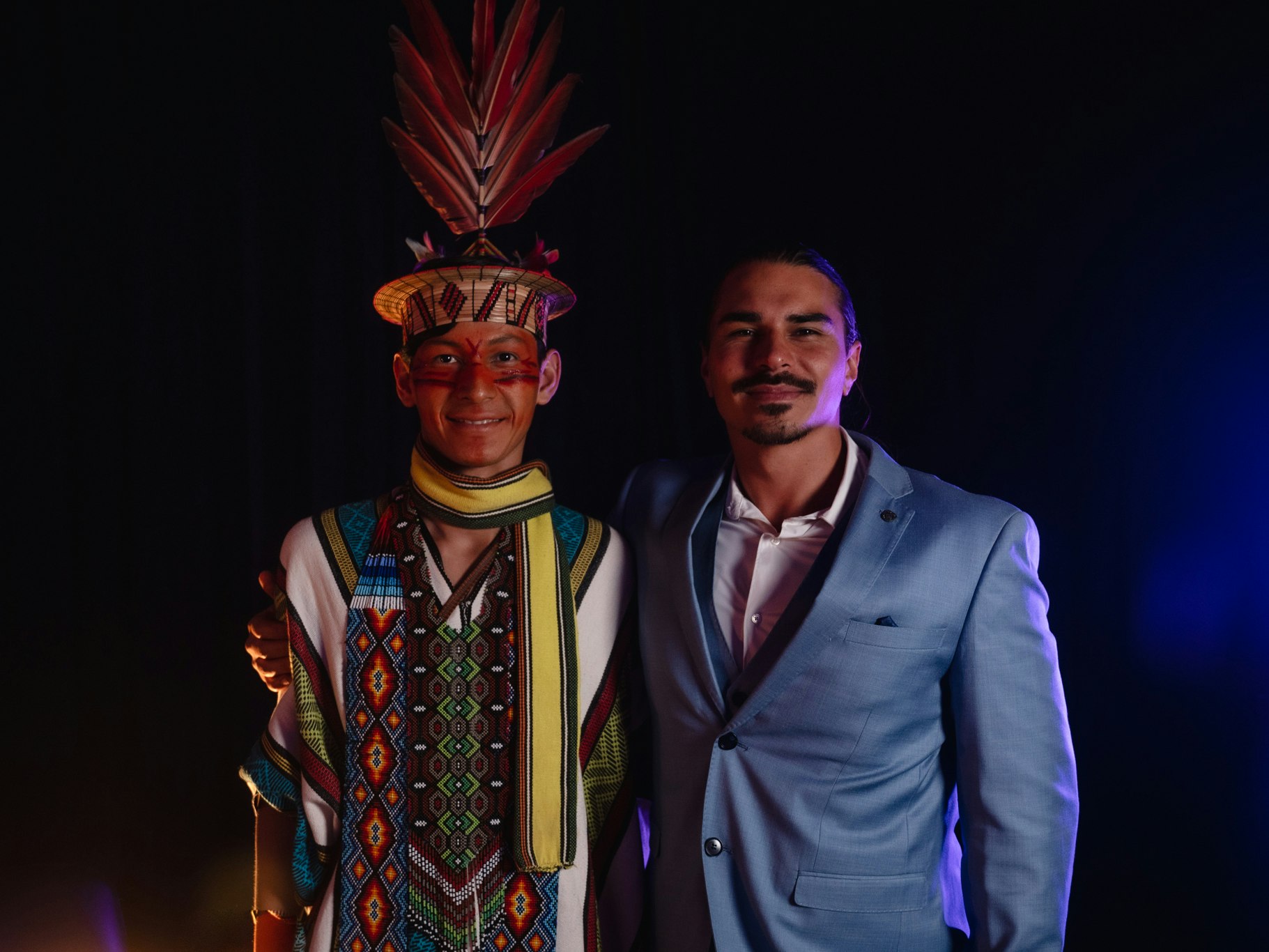


Interview with Ryan Whitewolf and Raine Piyako
Mar 13, 2026
Ryan Whitewolf and Raine Piyako on Music, Regeneration and Humanity’s Bond with Nature
What happens when music becomes more than sound, when it becomes a bridge between cultures, between generations, and between humanity and the earth itself?
In a new collaboration, composer and producer Ryan Whitewolf, founder of the Voice of the Earth Foundation, joins forces with Raine Piyako, Vice-President of the Yorenka Tasorentsi Institute and an indigenous singer from the Ashaninka tradition of the Amazon. Their work brings ancestral Indigenous songs together with symphonic orchestration - creating a musical experience rooted in nature, culture and regeneration.
But the music is only one part of the story. Behind it lies a deeper message about humanity’s relationship with soil, forests and the living planet.
In this conversation for Save Soil News, Ryan and Raine reflect on their connection to nature, the lessons carried by Indigenous traditions, the responsibility artists hold today, and the role music can play in rekindling humanity’s relationship with the earth.
What do soil and nature mean to you personally, like what is the meaning for you of soil in nature?
Raine:
“I am earth. I am soil. I am nature. I am the sun. I am the stars.”
— Raine Piyako
I was born in the forest and I am part of it. Since childhood I learned to care for it with my father and my uncles. The forest is our life, and we depend on it.
In the Ashaninka tradition, music is not just music. It is a prayer. A prayer with nature and with the beings around us. Through music we connect with everything that exists around us. We sing to give thanks: for food, for life, for each new day, and for everything the earth gives us.
In my music I listen to nature - to the birds, the water and the wind. All these beings are alive, and I have a relationship with them.
When people destroy nature and the earth, they destroy themselves. Today we see global warming and the springs of water drying up.
I can say I am a guardian of the forest, but in truth all of us are guardians. What is missing today is that people must look again at the forest and pay attention to nature. Too often people only take.
Through my music I hope people reconnect with nature and understand that the earth and the forest are our home.
My message is simple: reconnect with the earth, understand that we are part of it, and learn to live with it.
Ryan:
It almost feels like asking what life means to me.
In my late teens and early twenties, I was introduced deeply to different Indigenous elders. At that time I was suffering quite a lot, although I did not fully realize it until I experienced a deep emotional and spiritual connection with nature as a living being.
When I could truly feel nature - beyond an idea, beyond a belief - it filled a space in my heart that I did not even know was empty. That experience gave direction to my life and to the path I follow today, including the music I create.
Indigenous cultures around the world have carried this connection for thousands of years.
I have also brought friends and colleagues into these environments - people who had achieved great success in business, technology or entrepreneurship. From the outside they seemed to have everything, yet many of them were struggling with illness or inner dissatisfaction.
What I witnessed again and again is that when people truly feel that connection to nature, something changes.
Nature reminds us of reciprocity. Water nourishes the trees. Trees produce seeds. Birds carry those seeds. Everything participates in the cycle of life.
In a world filled with noise, distraction and rapid technological development, reconnecting with that depth of life becomes incredibly important.
“Soil and nature represent life itself. Every time we take care of soil and nature, we are taking care of life.”
— Ryan Whitewolf


Image: Ryan
Your community has actively worked to restore forests and regenerate large areas of nature. What has that process taught you about taking care of soil and ecosystems?
Raine:
In our community we work actively to restore the forest and regenerate the land. For many years my father has worked with young people in our village to reforest degraded areas and show that, by working with the land, it is possible to protect the forest and create life again.
My father, Benki Piyako, has planted around three million trees so far, and I have seen him doing this work every day. Our goal is to plant ten million trees, even though we know that number is still small compared with the vastness of the forest and the world.
When we plant trees and care for the land, we are also protecting the water sources of the forest. Water gives life to millions of beings — animals, plants and people. By protecting the forest where we live, we are also protecting life further down the rivers and across the whole ecosystem.
I learned these things from my father, my grandfather and my uncles. Since I was a child they took me into the forest so I could understand it and learn how to care for it.
My father often says:
“The land is my body. The water is my blood. The air is what allows me to live.”
— Benki Piyako
For younger generations in your community, what does this stewardship of soil and forest look like today?
Raine:
In our community, young people are first taught to care for nature and the forest where they live. This happens through the teachings of the elders. That is the key.
Our elders teach us that every plant and every species is part of us, and we are part of them.
The most important thing is that young people understand these values. When they do, they do not grow up destroying the forest or the ecosystems. Instead, they help regenerate them by reforesting, restoring land, and protecting nature.


Image: Raine
What responsibility do you feel as artists and, of course, as human beings, toward the future of soil and nature?
Raine:
My responsibility is to take care of the teachings I have received and share them with everyone who wants to listen. My concern is for the next generation, what could happen to the world in the coming years.
As Vice President of the Yorenka Tasorentsi Institute, I travel to share this message: it is not enough to simply observe nature. We must touch the earth. We must put our hands into the soil and plant.
My mission is to encourage younger generations not to forget their traditions, their language and their culture and not to forget their roots with nature and the forest.
Ryan:
I truly believe that all of us share a responsibility here.
The message I constantly remind myself of is that it is not about me. The identity of the artist can easily become very self-centered, but nature exists beyond the individual.
Part of my work as an artist is continually freeing myself from making it about me. There is a lot of beauty in that, because that is where the reconnection with nature begins. From that place, I believe the most powerful music emerges. And that is also where the strongest response from people comes from: when music is created from that space.
My responsibility as an artist is to let go of the “me” and recognize that it is about nature. About receiving the love that the earth constantly gives and asking how I can return that love through the music I create.
The mind is always trying to interfere, saying “sound like this” or “be like that.” But the best music comes when I let all of that go and simply say, “I love you” to the earth. That is when people are most deeply touched.
“The best music comes when I let everything go and simply say: ‘I love you’ to the earth.”
— Ryan Whitewolf
You founded the Voice of the Earth Foundation and initiated collaborations, like the one that you have with Raine. What inspired you to begin connecting Indigenous voices with symphonic music in service of nature?
Ryan:
There was a time when I traveled the world with different Indigenous elders and studied their ways of connecting with nature. I went very deeply into that experience. For example, for six years I did not wear shoes, and for about five years I lived without a phone or a bank account. I let go of many things in order to fully immerse myself in learning.
During that period I had a recurring meditation. It happened again and again while traveling with these elders to different places around the world. In that meditation I saw Indigenous elders from many tribes singing in front of orchestras.
At the same time I heard the words “Voice of the Earth.”
The meaning that came with it was that when people listen to this music, they are voting for the Earth’s consciousness (V.O.T.E).
Through my time with these elders I also saw how Indigenous cultures use music. Music is not simply entertainment - it is a way of connecting with nature and a way of healing.
At the same time, I had opportunities within the mainstream music industry in places like Los Angeles. Being inside that world made me realize how powerful music is in shaping society. Music carries energy and influences culture far beyond what we usually notice.
Some music amplifies consumerism or other things that disconnect people from life. I am not pointing fingers, but I felt the importance of creating something different. Something that could carry the wisdom of songs that have been passed down for thousands of years.
Many Indigenous songs hold ancestral integrity. They carry the energy of the earth itself and a deep healing force.
For me, the orchestra represents an expression of that Western ingenuity and cultural history, while the Indigenous songs carry ancient transmissions connected to the earth.
Bringing these two worlds together was a way of creating unity. Not saying one is right and the other is wrong, but creating a meeting point between modern society and ancestral knowledge.
The orchestral sound can support these Indigenous songs while preserving their integrity. It is not about changing them or turning them into something else. It is about carefully supporting the transmission that already exists.
Through this collaboration, the music becomes a bridge - a way for people to feel that connection beyond words.
In collaborating with communities like Raine’s, what has been your biggest learning?
Ryan:
My biggest learning is that the connection to the earth exists within all of us. It is something that lives in our genes and in our collective human history. For thousands of years, cultures all over the world lived in direct relationship with nature.
Even if modern societies have been disconnected from that relationship for generations, the connection is still within us.
When people experience it again there is often a deep sense of belonging and a feeling of coming home. That is something I have seen again and again. It reminds me that this relationship with the earth is not something foreign to us. It is something natural.
When these traditional Indigenous songs are shared with global audiences, what do you hope people understand about nature, soil, forest and regeneration?
Raine:
If we look back into history, we see that many Indigenous cultures and traditions have been lost. Many Indigenous people died defending their traditions, their cultures and their lands. For a long time there was prejudice and racism. People saying that Indigenous people did not know anything.
Through music, I hope people around the world can understand and value our traditions and the knowledge we carry. Indigenous people know what life is. We know what love is. We understand the gifts that life gives us every day.
I hope people feel unity, alliance, love and integrity. I hope people come together in peace and love to defend this earth together.
If we protect the earth, we protect the forests, the biodiversity and the biomes of the whole planet.
Ryan:
I hope people can truly feel a connection with nature. And I also hope they feel the sense of unity that Raine just spoke about.
Another thing I hope people feel is the beauty of regeneration - what it feels like when the earth begins to heal. When we come back into a relationship of reciprocity with nature, something changes within us. It restores something within the body and within the spirit.
When we give love to the earth, that love comes back to us. It creates a cycle of reciprocity.
So through the music I hope people feel respect for Indigenous cultures, feel a connection with nature, and experience the beauty of living in communion with the earth.
“When we give love to the earth, that love comes back to us.”
— Ryan Whitewolf
How does slowing down and truly listening change the way we engage with nature, with soil and with the earth?
Raine:
To connect with the earth, we need to touch it. We need to put our hands into the soil. We need to touch plants. We need to hug trees. Through that contact we begin to understand what nature means for our lives - what the forest means, what water means. We must also look inside ourselves and recognize what our life truly is to be able to connect to life itself.
My music is meant to wake people up. To wake up to life, to the new day, to the sun.It is never too late to reconnect with the earth. I am happy to be here on this earth.
Ryan:
For me the key words are truly listening.
Today our attention is constantly being pulled in many directions. There is social media, there is technology, there is artificial intelligence, and many other things competing for our attention. Because of this, people often lose their connection with silence and with deep listening.
Interestingly, music can sometimes help people reconnect with that. Music can guide people into a space where they feel safe enough to slow down and listen.
When we truly listen - not only to music but also to nature - something begins to shift. We stop focusing on our worries, our work or our stress, and we reconnect with something deeper. In that silence and in that listening, healing can happen.
What would true regeneration look like for humanity’s relationship with nature and with the earth?
Raine:
Today we see a lot of destruction in the world. We see deforestation happening everywhere.
When forests are destroyed, the imbalance in the world grows. We see global warming, wildfires in some places and floods in others. This imbalance shows us that something is wrong.
Regeneration means restoring balance. It means moving away from destruction and extraction and creating the conditions where ecosystems can recover and life can flourish again.
Many organizations and initiatives today are working to create awareness and encourage people to protect nature and restore ecosystems. This work is essential so that people stop destroying the forests and begin restoring balance in the world.
Ryan:
If regeneration became a guiding principle across society, I believe we could achieve incredible things.
If that philosophy and those ethics were integrated into all aspects of life - politics, media, technology, innovation - humanity could move in a very different direction.
Human beings have tremendous creativity and intelligence. We are capable of amazing things. If billions of people truly understood the importance of caring for the earth, that awareness would ripple across cultures and societies.
Regenerating the earth would not only restore ecosystems - it would also bring unity and healing to humanity.
If you could share one message with the world about soil, nature, forest and your community’s relationship with nature, what would it be?
Raine:
My message to the world is simple: wake up and look around.
Imagine if every person on earth planted just one seed. Billions of people planting one seed could restore life everywhere.
Let us come together in alliance and unity. Let us love and forgive each other so we can live this life together and restore life on this planet.
“When you help the forest, you help yourself.
When you help the earth, you help yourself.”
— Raine Piyako
Ryan, what’s next for the Voice of the Earth Foundation?
Ryan:
In a few days we are traveling to Kenya to work with the Kikuyu community.
There is a cultural renaissance happening there. Many traditional songs that we will record have never been recorded before. We received permission from the council of elders, and we will be documenting ceremonies, interviewing elders and recording singers.
The project will include a documentary and an album featuring fifteen Kikuyu singers. We will also film in the natural landscapes of Kenya, including the savanna and the wildlife.
For us it is a great honor to capture these songs and help share them with the world.
The most beautiful part is that younger generations in Kenya are reconnecting with their traditions, their songs and their prayers. If this project can help inspire young people to feel proud of their culture and keep those traditions alive, then it will have achieved something meaningful.

LET US MAKE IT HAPPEN!