



Interview with Going Green Media
Jan 13, 2026
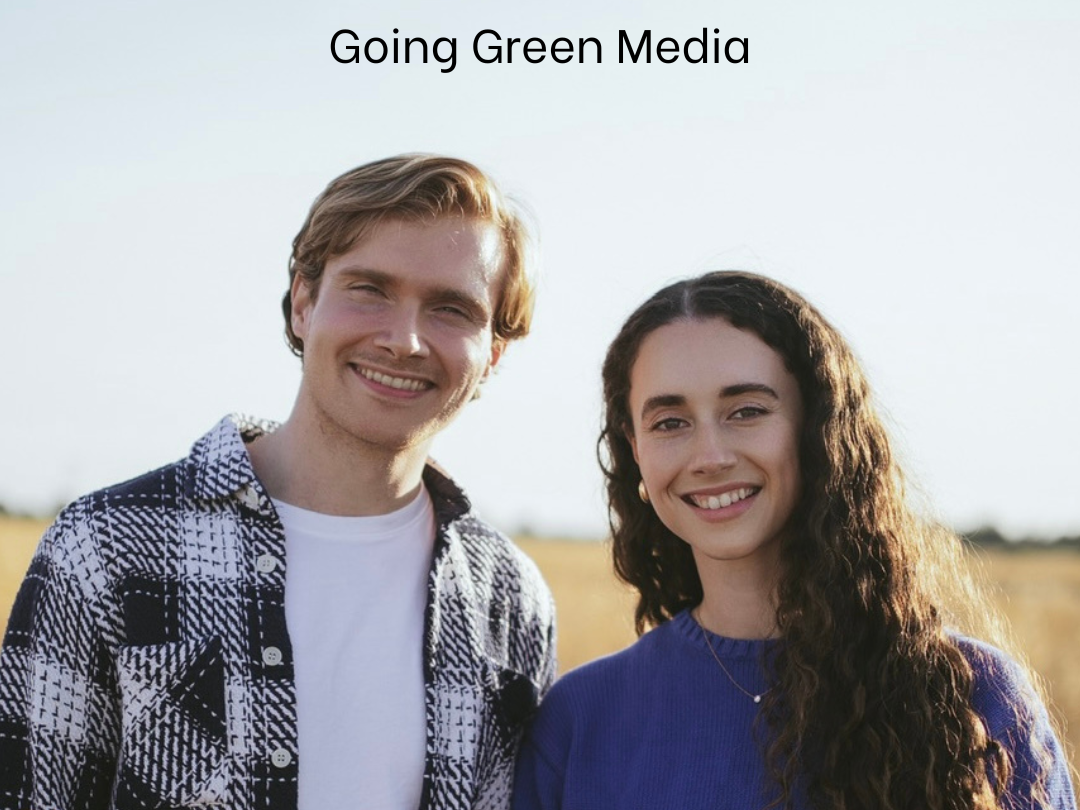
Going Green Media has become one of the most influential sustainability voices online, reaching over 250 million people with solution-focused environmental storytelling. Founded by Ben and Ciara, the platform was born from a shared frustration with fear-driven climate narratives and a belief that inspiration is a powerful catalyst for action. Through exploring human-centred stories, maintaining rigorous anti-greenwashing standards and focusing on solutions already in place, Going Green Media explains how conscious media can drive real-world impact.
Grounded in first-hand experiences with regenerative communities such as Aardehuis in the Netherlands, their storytelling amplifies regenerative agriculture, soil health, and movements like Save Soil - recognising healthy soil as not just an environmental concern, but the foundation for climate resilience, food security, and thriving communities. Crucially, they also call for evolved media systems that make meaningful action as accessible as awareness.


It’s been inspiring to watch Going Green Media grow into such a widely recognised sustainability platform. What sparked this journey for you - was there a moment you decided that social media could be a tool for environmental impact?
Our journey began from two different places that converged into one shared mission. Ben was experiencing eco-anxiety during his Architecture studies at Loughborough University, feeling completely disconnected from meaningful climate action and overwhelmed by doom-and-gloom environmental narratives. Ciara, coming from a background in television and journalism, was passionate about engaging storytelling but frustrated by the lack of optimistic, solution-oriented climate media.
In 2019, Ben bought a second-hand camera to document sustainable architecture, and realised nobody was consistently showcasing solutions that already exist and are working right now. We saw how social media could reach millions who would never read a scientific journal but would stop scrolling for a 60-second story about turning food waste into leather.
The turning point was realising inspiration is just as important as information. We identified three missing elements in climate communication: acknowledging small businesses’ power, recognising everyone can contribute, and highlighting solutions having an impact today. Social media became our tool not just to inform, but to inspire action.
Your work has taken you into conversation with an incredible range of people and organisations working on the ground. Can you tell us about a collaboration or project that has stayed with you, and why?
Our first feature documentary, “Heart of the Wild: Africa’s Wildlife Rangers,” created with Tusk Trust, fundamentally changed how we understand conservation. We spent time with rangers risking their lives daily to protect ecosystems critical to soil health, water cycles, and climate regulation.
What stayed with me wasn’t just the scale of the challenge, but the humanity of these individuals. These weren’t just conservation stories - they were stories about communities whose livelihoods, culture, and futures are directly tied to healthy land. The rangers taught me that you cannot separate environmental protection from human wellbeing. Healthy soil supports the vegetation that wildlife depends on, which in turn supports tourism that funds schools and healthcare for local communities.
One of the most powerful things about storytelling is often how it’s received - sometimes in unexpected ways. What’s the most surprising response you’ve ever received from your audience?
The most surprising responses come from people who’ve completely changed career paths after watching our content - engineers retraining as environmental consultants, students changing majors, all because they saw working on climate solutions could be creative, hopeful, and impactful.
One teacher said our content was the first time her students engaged with climate topics without feeling hopeless. That showed us we weren’t just reaching individuals - we were shifting how entire communities think about environmental action. With our community across the world, we’ve learnt that climate anxiety and the hunger for hope are universal.
For sure - and with a growing global audience, your content clearly reaches people from many different backgrounds. What do you think makes environmental content really resonate with people online?
Through reaching over 250 million views and 1 million+ followers, we’ve learnt three key elements:
First, authenticity over perfection. We only work with thoroughly vetted organisations across our 100+ partnerships. We’ve turned down lucrative deals that didn’t align with our values. Our audience trusts us because we maintain rigorous anti-greenwashing standards.
Second, human stories over statistics. Nobody changes behaviour because of a graph. They change because they connected with someone’s story. Ciara’s television background and Ben’s architectural eye help us craft narratives that are emotionally compelling and visually striking.
Third, solutions over problems. Every piece highlights a working solution. We show the future is already being built by incredible people worldwide. That shift from fear to hope is what makes people engage, share, and take action.

Hearing about that reach naturally raises the topic of real-world influence. Can you share a moment when you realised your content had made a real difference in someone’s life or choices? How have your experiences informed your own choices?
One of the most tangible examples of our impact was when we helped a sustainable project grow their social media following by over 100,000 followers after highlighting their work in a single video. Seeing how our platform could directly amplify smaller organisations doing incredible work showed us the real power of what we’ve built - we’re not just informing audiences, we’re creating opportunities for solutions to scale.
Starting Going Green Media forced us to examine everything from travel emissions to low-carbon website design. The innovators we’ve documented taught us that real change combines personal action with systemic advocacy - we use our platform to amplify solutions and pressure larger entities to do better.
Along with awareness, your work consistently encourages people to rethink how they engage with sustainability. What types of content or storytelling have you found most effective at inspiring actual behavioural shifts?
Through our work across platforms - from short-form social content to our feature documentary to The Inspire Action Podcast - we’ve identified several formats that consistently drive behavior change:
Short-form educational content that shows immediate, tangible impact has been remarkably effective. Videos that take complex concepts - like regenerative agriculture or circular economy - and break them down into 60-90 seconds with striking visuals consistently perform best.
Before-and-after transformations make abstract concepts concrete and prove transformation is possible.
Unexpected solutions like mushroom leather or energy-producing buildings challenge assumptions. That shift - realising sustainability is about innovation, not sacrifice - is when mindsets change.
The podcast format has opened new possibilities for deeper behavioral shifts. While short-form content sparks initial interest, long-form conversations with scientists, farmers, and innovators on The Inspire Action Podcast allow audiences to understand the ‘why’ and ‘how’ behind solutions.
What ties all effective content together is actionability. We always try to show that solutions aren’t ten years away - they’re happening right now, and viewers can support them, advocate for them, or implement them in their own contexts.
That’s really inspiring to hear. Listening to how you approach storytelling and partnerships, it’s clear that intention plays a big role in your work. What does ‘conscious media’ mean to you, and how has that definition evolved over time?
Initially, we thought conscious media just meant creating environmental content. Five years in, our definition has fundamentally evolved.
Conscious media means intentionality at every level: practising what we preach with low-carbon travel; maintaining anti-greenwashing standards even when costly; amplifying women- and BIPOC-led businesses; prioritising accuracy over virality; and measuring impact beyond metrics.
We’ve reached 250 million views, but conscious media asks: What changed because of those views? Did we inspire action? Did we support critical work?
It also means acknowledging our limitations. We’re constantly learning and listening when our community challenges us to do better. That humility is essential. Launching The Inspire Action Podcast wasn’t just about reach - it was about giving our community tools to understand complex issues and feel equipped to take action.
That’s very insightful. Through your travels and storytelling, you’ve encountered communities living in deep connection with the land. Have you encountered a farmer, community, or ecosystem that captures why movements like Save Soil are so urgent?
In May 2024, we visited Aardehuis in the Netherlands - a community that fundamentally changed how we understand the relationship between soil, food, and housing. This community is growing their own food and building their own homes, living in a way that demonstrates what’s possible when you centre soil health in every decision.
What struck us most was how everything came back to the soil. They weren’t just growing food - they were regenerating the earth beneath their feet, understanding that healthy soil is the foundation for everything: nutritious food, sustainable building materials, clean water, biodiversity, and community resilience. You could see it in the quality of their produce, feel it in the earth they were building with, and hear it in how they spoke about their relationship with the land.
Watching this community thrive by working with soil rather than against it perfectly captures why movements like Save Soil are so urgent. They’re proving that when we prioritise soil health, we don’t just solve one problem - we address food security, housing, climate resilience, and community wellbeing all at once. It’s the foundation that makes everything else possible.
This is exactly the kind of story we need to tell more of - showing that regenerating our relationship with soil isn’t a sacrifice, it’s a pathway to abundance and genuine security.
Looking ahead, it feels like the tools themselves also need to evolve to meet the scale of the challenges we’re facing. If social media could evolve in a way that better supports environmental creators and movements like Save Soil, what would that look like?
Algorithmic prioritisation of educational content over entertainment. Platforms should elevate well-researched, solution-oriented content that drives impact.
Better monetisation for purpose-driven creators. Environmental content is consistently demonetised compared to traditional entertainment. We’ve built sustainability through brand partnerships, but not every creator has that access.
Features that facilitate action, not just awareness. Every post should include direct links to petitions, donations, or local initiatives. We shouldn’t rely on “link in bio” workarounds.
Protection against greenwashing through verification systems for environmental claims, helping authentic movements like Save Soil cut through corporate noise.
Social media platforms have proven they can change what billions see, think, and do. Now they need to consciously choose to amplify solutions that will determine whether we have a livable planet. We’ve proven solution-oriented content can reach millions - imagine what we could achieve if platforms were designed to support this work rather than just tolerate it.

Discover more about Going Green Media here
Check out their Instagram

LET US MAKE IT HAPPEN!